To control worms, you have to understand how they live. The good news is that most of the gastrointestinal worms of grazing animals — across sheep, goats, cattle and horses — share the same basic, direct lifecycle. And that lifecycle contains a single factt hat reshapes everything about control.
The cycle in brief
Adult worms in the animal’s gut lay eggs, which pass out in the dung. On the pasture, those eggs hatch and develop through larval stages to an infective stage. Grazing animals swallow the infective larvae, which mature into adults inside the gut — and the cycle begins again. For many species the whole loop takes only about three weeks.
The fact that changes everything
At any one time, only around 10% of the worm population is inside your animals. The other 90% is out on the pasture, as eggs and larvae. This is the reason drenching alone has never been enough: a drench acts on the 10% inside the animal, while the 90% waiting on the pasture re-infects them within days or weeks. Lasting control has to address the pasture, not just the animal.
Explore the detail
- Egg → Larvae → Pasture → Host — a walk through each stage of the journey.
- Intervention Points — where, and how, the cycle can be broken.
- As you’ll see, the stage where larvae develop in the dung is the lifecycle’s great bottleneck — and the point biological control is aimed squarely at.
Egg → Larvae → Pasture → Host
Here is the journey a typical gut worm takes, stage by stage.
Egg — in the dung
It starts with the adult worms in the animal’s gut. Females lay eggs — some species in their hundreds per day, the barber’s pole worm in its thousands — and these pass out onto the pasture in the dung. The dung pat is the nursery: warm, moist and full of nutrients.
Larvae — developing in the manure
The eggs hatch into first-stage larvae (L1), which feed on bacteria in the dung and moult to second-stage larvae (L2). These early stages are fragile — easily killed by drying and cold — and they remain in the dung pat. Within about a week in warm, moist conditions they moult again into the infective third stage (L3).
Pasture — the infective larva waits
The L3 is the survivor of the family. It is sealed inside a retained protective sheath, doesn’t feed, and is far hardier than the earlier stages. In a film of moisture it migrates out of the dung and a few centimetres up the grass — clustering low on the sward, where grazing animals feed closest. Depending on the weather, L3 can survive from weeks to several months on pasture. This is the reservoir — the 90% of the population waiting on the ground.
Host — back inside the animal
A grazing animal swallows the infective larvae along with the grass. Inside the gut, host signals trigger them to develop through a fourth larval stage (L4) into adult worms, which begin laying eggs of their own. Some larvae pause their development inside the animal (a state called hypobiosis) to ride out hostile seasons, emerging later. And the cycle turns again.
Two worms break the rules: A few species don’t follow this template — the thin-necked intestinal worm and the horse ascarid both develop inside an exceptionally tough egg on the ground rather than as a free larva, which is why they’re controlled differently. See their individual pages for detail.
Intervention Points
Every worm-control tool works by breaking the lifecycle at a particular point. Seeing them laid out together explains why combining tools is so much more powerful than relying on any one.
1. In the animal — the adult worms
Drenches kill the adult and immature worms living in the gut. This is essential for treating sick animals and clearing burdens — but it does nothing to the eggs and larvae already on the pasture, and its power is being eroded by resistance.
2. In the dung — the developing larvae
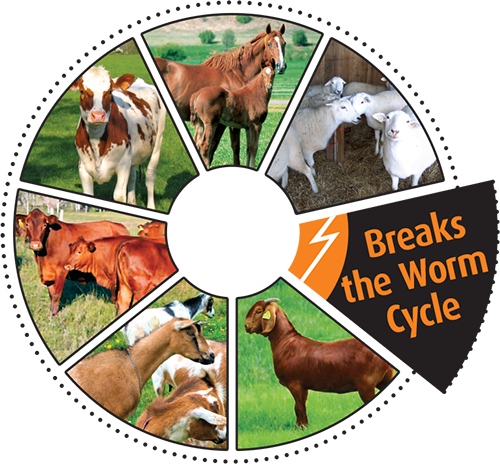
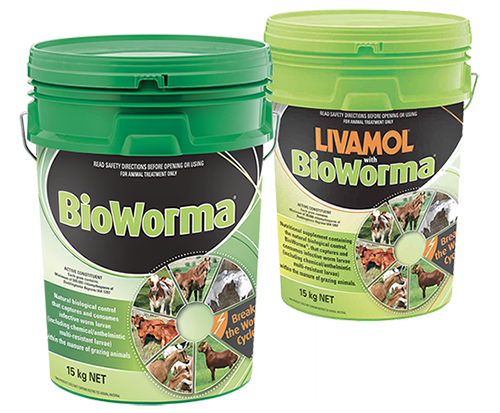
This is where biological control works. The natural fungus Duddingtonia flagrans (the active in BioWorma) traps and consumes worm larvae inside the dung pat, before they can migrate onto the pasture — including drench-resistant larvae. Dung beetles and other manure-dwelling fauna also help disperse and dry out dung, reducing larval survival.
3. On the pasture — the infective larvae
Out on the sward, time and weather do much of the work — heat, drying and cold all kill larvae. Producers harness this with resting and spelling paddocks, rotational grazing, and cross-grazing with another species (most worms are host-specific and reach a dead end in the wrong host).
4. At the host’s defences — resisting infection
Finally, the animal itself can be strengthened. Good nutrition helps stock resist and tolerate worms; genetic selection builds flocks and herds that carry fewer worms; and vaccines, where available (such as a vaccine against barber’s pole worm), prime the animal’s own immunity.
Why hit several at once
No single intervention point is enough on its own — and over-using any one (especially drenching) creates its own problems. Breaking the cycle at several points at the same time has a cumulative effect: pasture infectivity falls, fewer worms are picked up, and reliance on chemicals drops. The dung stage is especially valuable, because it’s where biological control can reduce the 90% of the population on pasture without using chemicals or driving resistance.