Introduction
Sheep almost always carry a mix of gut worms at once. Knowing which ones dominate in your region and season is the first step to controlling them without over-relying on drenches.
The worms that matter most
- Barber’s pole worm (Haemonchus contortus) — a blood-feeder causing anaemia and sudden death, worst in warm, humid and summer-rainfall conditions.
- Black scour worm (Trichostrongylus) — one of the most common worms, causing dark scouring and wasting; significant worldwide and a major issue in New Zealand and temperate zones.
- Brown stomach worm (Teladorsagia / Ostertagiacircumcincta) — a key cause of scouring and ill-thrift, especially in cooler, winter-rainfall areas.
- Thin-necked intestinal worm (Nematodirus)— strikes young lambs suddenly in spring through its weather-triggered hatch.
- Nodule worm (Oesophagostomum) — forms nodules in the gut wall (“knotty gut”).
Depending on region, liver fluke and other worms such as the large-mouthed bowel worm can also feature. For full detail on each, see the Science & Parasites section.
Who is most at risk
Weaners and lambing ewes are the most vulnerable — ewes shed more eggs around lambing (the periparturient rise), contaminating pasture just as lambs start to graze.
Parasite Management for Sheep
With drench resistance now widespread in sheep worms, sustainable control means treating on need rather than habit, and lowering the worm challenge from the pasture so you treat less often.
Monitor first
- Worm-egg counts (WormTest) to decide if and when to drench.
- FAMACHA eyelid scoring for barber’s pole worm,to treat only anaemic animals.
- Larval culture to identify species, and a drench test (egg count reduction test) to confirm what still works on your property.
Drench to protect the drench
Resistance to the older whiteand clear drenches is very common, and resistance to the mectins is growing.Use only products proven effective for you, often as combinations; dose to theheaviest animals in the group; quarantine-drench incoming stock; and preserverefugia through targeted, selective treatment rather than blanket drenching.
Graze strategically
Rest and rotate pasture to let larvae die off, cross-graze with cattle, and prepare low-worm-risk paddocks for your most vulnerable stock — weaners and lambing ewes. Support animals with good nutrition (especially protein), and select for worm resistance over time using available breeding values for worm-egg count.
Regional programs: Tap your local best-practice program — for example ParaBoss / WormBoss in Australia, Wormwise in New Zealand, SCOPS in the UK, and the small-ruminant parasite resources in the USA — for region-specific timing and thresholds.
Using BioWorma in Sheep
In sheep, BioWorma reduced worm larvae on pasture by an average of around 68% in the company’s trials. That matters most where resistance is eroding your drenches: cutting the larvae on pasture means fewer worms picked up, and less pressure on the products you have left.
What it does
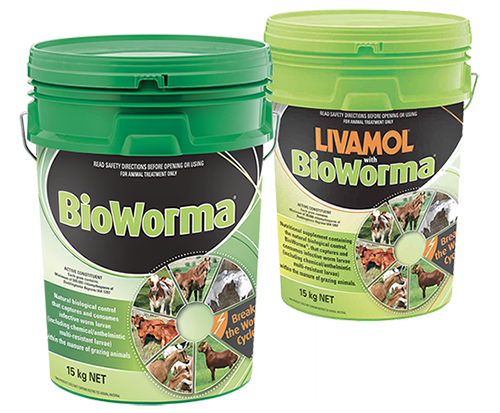
Fed daily, the natural fungus Duddingtonia flagrans passes through the sheep in its tough spore form and germinates in the dung, where it traps and consumes worm larvae — including drench-resistant larvae — before they migrate onto the pasture. It acts on the gut roundworms whose larvae develop in the manure pat, such as barber’s pole, black scour, brown stomach and nodule worms, and hookworm.
How it’s fed
It is fed every day, scaled to bodyweight — as the concentrated additive mixed through feed, or as Livamol with BioWorma, a ready-to-use supplement. Because the fungus doesn’t persist on the farm, it needs continuous feeding through the risk period, and is best used strategically when conditions favour larval development (temperatures above about 5°C). In group feeding, make sure all sheep get even access so each contributes treated dung.
How it fits
BioWorma lowers reinfection from pasture; it does not kill worms already inside the sheep, so you still drench clinical cases and existing burdens. It works well around the high-risk periods — protecting weaners and reducing the contamination ewes shed around lambing — and because it acts physically rather than chemically, it lowers pasture larvae without adding selection pressure for resistance. It is residue-free and harmless to dung beetles, earthworms and soil life.
Animals Overview