Introduction
In cattle, worms take their biggest toll on young, growing animals. Most cattle build solid immunity by about two years of age, so the focus falls on calves, weaners and yearlings — where the production losses, and the resistance risks, are greatest.
The worms that matter most
- Brown stomach worm (Ostertagia ostertagi) — the most important and damaging worm of cattle in temperate regions. It suppresses appetite and growth, and immunity to it develops slowly. Disease comes in two forms: Type I in young cattle through autumn and winter, and Type II around first calving, when larvae that had paused in the stomach wall emerge together.
- Small intestinal worm (Cooperia) — the most common cattle worm. Less damaging per worm, but present in huge numbers, and the main drench-resistance concern in cattle.
- Stomach hair worm (Trichostrongylus axei) — usually minor, but the one common worm shared between cattle, sheep and horses; can dominate some autumn outbreaks.
- Barber’s pole worm (Haemonchus placei) and nodule worm (Oesophagostomum radiatum) — important in warmer regions.
Beyond the gut roundworms, lung worm (Dictyocaulus viviparus, or “husk”) causes coughing and ill-thrift in young cattle in wetter temperate areas, and liver fluke matters on wet country.
Who is most at risk
Calves, weaners and yearlings under about two years old. Adults are usually immune, though first-calvers, bulls and stressed animals can still need attention, and new arrivals should be quarantine-drenched.
Parasite Management for Cattle
Effective cattle worm control concentrates effort on young stock, chooses products suited to the main worms, and keeps a close eye on resistance — particularly in Cooperia.
Monitor
Use worm-egg counts in cattle under about two years, but interpret them with care: Ostertagia produces relatively few eggs yet does great damage, while Cooperia produces many eggs but is less harmful per worm — so always weigh the egg count against how the cattle look. Check that a drench has worked by re-testing egg counts about 10–14 days afterwards.
Drench
Because immunity to Ostertagiais slow to develop and the worm can pause in the stomach wall, persistent products (often the macrocyclic lactones) are valued for young cattle, including for clearing those arrested stages. But Cooperia resistance to the mectins is now common in some regions, so effective combinations — and confirming efficacy by testing — matter. Quarantine-drench all incoming cattle.
Graze strategically
Rest and rotate pasture so larvae die off, cross-graze with sheep, horses or immune adult cattle to help clean paddocks, and prepare low-worm-risk pasture for weaners. Time treatments to the worms’ seasonal pattern and to key points such as weaning. Reducing the larvae cattle pick up from the pasture eases the whole system — see Using BioWorma in Cattle.
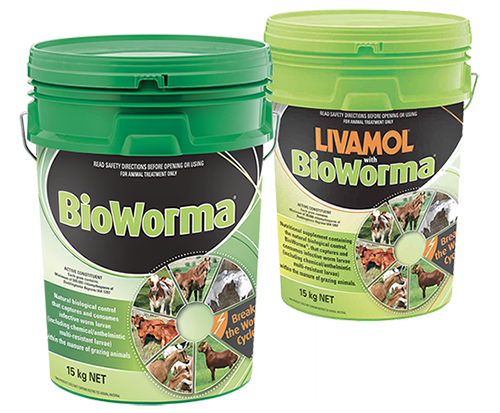
Using BioWorma in Cattle
In cattle, BioWorma reduced worm larvae on pasture by an average of around 81% in the company’s trials. With Cooperia resistance to the mectins now common, removing larvae from the pasture — including resistant larvae — is a useful, non-chemical way to take pressure off the drenches.
What it does
Fed daily, the natural fungus Duddingtonia flagrans passes through the animal in its tough spore form and acts in the dung pat, trapping and consuming worm larvae before they spread onto the pasture. In cattle this targets the gut roundworms whose larvae develop in the manure — brown stomach worm (Ostertagia), small intestinal worm (Cooperia), barber’s pole, stomach hair worm and nodule worm.
How it’s fed
It is fed every day, scaled to bodyweight, mixed through feed, a supplement or a lick/loose mix so the whole mob gets even access. Because the fungus doesn’t establish on the farm, it needs continuous feeding through the risk period, and is best used strategically when conditions favour larval development (temperatures above about 5°C).
How it fits
BioWorma reduces reinfection from pasture; it does not kill worms already inside the animal, so cattle with existing burdens still need an effective drench. It also does not control lungworm or liver fluke, which aren’t picked up as larvae from the dung pat the same way. Used alongside monitoring, targeted drenching and grazing, it lowers pasture contamination for young cattle while leaving refugia intact — and it’s residue-free and harmless to dung beetles, earthworms and the soil life that keep pasture healthy.
Animals Overview